![]()
“I always believe that it is much better to have a variety of
religions, a variety of philosophies, rather than one single religion
or philosophy. This is necessary because of the different mental
dispositions of each human being. Each religion has certain
unique ideas or techniques, and learning about them can only
enrich one’s own faith.”
- His Holiness the Dalai Lama
India is home to the largest number of religions in the world. The context of this rich tapestry is a challenging ground for interfaith explorations.
In a region where faith mediates everyday life in a palpable sense, the Interfaith Dialogue project provides an invaluable resource to understand India’s religious diversity.
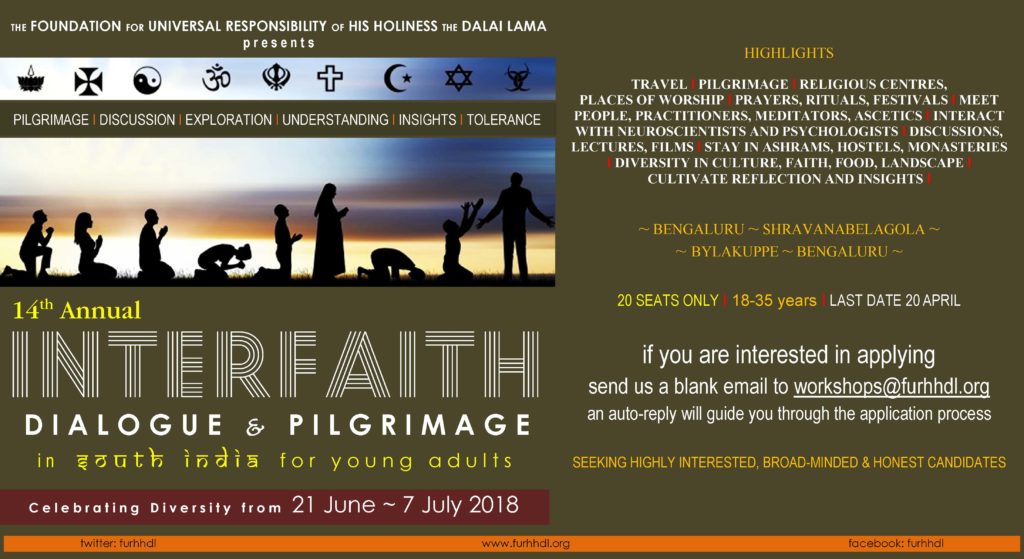
In an effort to build cross-cultural understanding and encourage spiritual enquiry through the first hand exploration of different faith traditions, the Foundation brings together groups of young people for Interfaith Dialogues. The participants go through an experiential journey that spans different religious beliefs and practices. While staying in monasteries, ashrams and other spiritual and religious centers, students devote time studying and exploring the basic tenets of Christianity, Buddhism, Sikhism, Hinduism, Islam, Judaism, Zoroastrianism, Jainism and other lesser-known faiths. They interact with religious philosophers and masters who share with them religious tenets and spiritual practices. The program includes lectures, discussions and films on the rituals and history of various religions.
The Foundation offers a space for dialogue among diverse faith and cultural traditions. The Foundation hopes that through such engagement, an active and sustained culture of nonviolence and coexistence may be nurtured.
“His Holiness the Dalai Lama
is one of the great spiritual statesmen of our times.
His Foundation for Universal Responsibility
is a worthy instrument for his vision.
Its time has come to reach beyond the subcontinent to the world.
There is so much to do.”
– Prof. U.R. Ananthamurthy
Eminent Writer & Poet

![]()
"I appreciate any organization or
individuals who sincerely make an
effort to promote harmony between
humanity, and particularly harmony
between the various religions.
I consder it very sacred and
very important work."
– His Holiness the Dalai Lama
![]()

![]()
The Attending to Life project offered holistic perspectives on alternate ways of life to schoolchildren. It sought to equip students with strong ethical tools to cope with the complexities of the changing world. Through interactive discussions, self reflection, films, role plays and lectures, students were provided a safe space to engage with new ways of thinking, understand altruism and cultivate mindfulness.
![]()
The popular lecture series, provided a forum for a spectrum of great minds including eminent scientists, religious thinkers, philosophers and artists to share their insights on questions of spirituality, truth and the creeds by which they live. The series was intended to stimulate interdisciplinary and interfaith conversations. Over three years, the series foregrounded insights of more than fifty leading thinkers.

Mr. Rajiv Mehrotra, Secretary, FUR; Mr. U.R. Ananthamurthy,
renowned author; Mr. Karan Singh, political leader and diplomat;
Mr. Arun Shourie, political leader, journalist and author; and
Prof. C. Raja Mohan, Nanyang Technological University, Singapore,
at ‘Celebrate The Dalai Lama’, an event organized by FUR
to mark His Holiness’s 70th birthday
![]()
To engage with the world of ‘sadhana’, the Foundation organized a monthly forum where musicians, painters, dancers, sculptors and other artists presented both the intellectual and experiential aspects of the art forms to which they are devoted.
![]()
The initiative India’s Quest celebrated the anniversary of India’s independence. It provided a rich array of instructional materials and films that engage with the challenges and opportunities in the working of India’s democracy.
India’s Quest used the medium of documentary film to reach out to people, pose incisive questions and catalyze a national debate on key issues such as Enriching Diversity, Universal Responsibility and Nonviolence, Environment and Technology, Pluralism and Gender, Governance and Education.
As part of the Campus Outreach Program, seven half-hour documentary films were screened at campuses across the country, to stimulate debate and discussion on these core issues. The films were also screened on television, at film festivals and other venues that are accessible to a cross-section of communities in India and abroad.
The Society for Promotion of Indian Classical Music and Culture Amongst Youth (SPICMACAY), a nationwide movement of young people, collaborated with the Foundation on the India’s Quest project.
![]()
The workshops on The Culture of Breath aspire to build on the growing interest in healing within the different faith traditions, which have arisen over the past few years, and explore the process of healing using breath as the prime component.
Through the workshops, the Foundation hopes to:

![]()
“The experience of attending the
Interfaith Dialogue Program has
changed the way I see the world and
myself. It has taught me the importance
of universal brotherhood and self-
realization.”
– Anand Singh, Student
Indian Institute of Technology
![]()

![]()
"Having participated in the program,
I now understand how important it is
to take interest in and have an open
mind towards other cultures and
ways of thinking”.
– Yeshi Wangmo
Buddhist Nun
![]()
India’s and humanity’s ongoing struggle for comprehending the true meaning of Svaraj provided the context for interactions at the workshop. Attempts were made to understand issues of War and Peace against the backdrop of The Mahabharata, with the aid of the philosophical tradition of Advaita Vedanta.
![]()
Participants gathered with a spiritual practitioner representing a particular faith, to learn about the role of meditation in that faith and experience the practice through a guided meditation.
“I am deeply impressed that an institution set up by a
great Buddhist leader openly encourages and creates an opportunity for people of
all traditions to learn about each other, not just about theories and similarities, but
the actual experience of practices and techniques. It celebrates diversity.”
– Late Swami Gokulananda
Head, Ramakrishna Mission, New Delhi, India
![]()
Scholars and practitioners from different faiths and walks of life shared their insights with the audience, encouraging them to understand these questions in order to further meaningful and wise living.

Dr. Ausaf Ali, former Chancellor,
Jamia Hamdard University;
Maulana Wahiduddin Khan, and Father Daly S.J.
at the seminar, 'Understanding Death'
![]()

Discerning the Spirit in Sound: Chantin, a popular seminar, explored the role of sound and
chanting in different faith traditions. It examined the impact of sound on the physical and spiritual dimensions of human life. Scholars, theorists, medical practitioners, anthropologists, folklorists, artists and students engaged in stimulating dialogue on the ways in which chanting can enrich contemporary human existence. Thematic panels included Mantra and Tantra, Zikr and Sama, the Sufi Way and the Power of the Noble Quran as the Spoken Word.
![]()
Ven. Mathieu Ricard conducted a workshop on ‘Cultivating Happiness as a Skill’ for an international audience in New Delhi. A Buddhist monk living at
the Shechen Monastery in Nepal, Ven. Ricard shared insights from recent
research on the partnerships between science
and Buddhism. A
member of the Mind and Life Institute, Colorado, USA, his work seeks to
synthesize 25 centuries of the wisdom of Buddhism with the neuroscience
of the 21st century. The workshop also included screenings of, and
discussions on, the films Mystical Brain (which highlights scientific research on the states of grace experienced by mystics and mediators) and Cave in the Snow (a journey in the path of spirituality). Ven. Ricard is the author of best-sellers such as The Monk and the Philosopher, The Quantum and the Lotus, and Happiness: A Guide to Developing Life’s Most Important Skill.
![]()

The Foundation organizes annual Teachings by His Holiness the Dalai Lama about Buddhist Philosophy, Teachings and Practice for Buddhists and non Buddhists alike. The teachings provide space for experiential learning, dialogue and discussion. It is not necessary to be a Buddhist to attend these and derive value from them. The Dalai Lama urges us to learn from all traditions.
![]()

Ven. Geshe Lhakdor, Director of the Library of Tibetan Works and Archives, Dharamsala, conducted a Public Teaching on the Four NobleTruths. He has served as His Holiness the Dalai Lama’s religious assistant and translator for many years and represents His Holiness’s vision and work at national and international forums.
Over the course of six days, Ven. Lhakdor walked the audience through an enlightening discourse on the central and pivotal Buddhist teaching – The Four Noble Truths. Illuminating the Noble Eightfold Path, he led an interactive session on the precepts of Buddhism: the existence of impermanence; the arising of suffering because of attachment/craving; the cessation of suffering; and, the middle way or the noble eightfold path. The teachings by Ven. Lhakdor are now an annual feature.
![]()